Last Updated on July 27, 2026 by Carlo Dach
A print can look finished long before it is ready for lamination. The surface may feel dry, yet solvent can remain inside the vinyl. Seal it beneath laminate too early, and the result may be bubbles, lifting edges, softened adhesive, or a difficult installation.
TR2 is an eco-solvent ink system developed for Roland TrueVIS equipment. It supports durable graphics and can allow faster finishing than many traditional solvent workflows. Still, faster drying does not eliminate outgassing. Ink coverage, media, profiles, airflow, temperature, and the final application influence when a print is truly ready.
Table of Contents
Can TR2 Ink Damage Vinyl Adhesive If It Is Not Fully Dry?
Can TR2 Ink Damage Vinyl Adhesive If It Is Not Fully Dry? Yes, retained solvent can affect pressure-sensitive adhesive, particularly after the print is laminated or tightly rolled. It may soften the film or adhesive layer, reduce initial tack, and make the material less willing to remain seated around edges, curves, channels, and rivets.
The failure may not appear immediately. A graphic can look normal on a worktable and begin lifting after installation when heat, tension, and weather place more stress on it. Vehicle wraps and wall graphics often expose incomplete outgassing quickly because the vinyl must remain stable across large or uneven surfaces.
Surface Dry Is Not Fully Dry
Eco-solvent ink dries as carrier solvents leave the printed surface. The upper layer can feel dry while solvent remains deeper in the ink and media, especially in saturated photographs, dense blacks, or broad areas of solid color. Touching a corner is therefore not a dependable test.
Why Can TR2 Ink Damage Vinyl Adhesive If It Is Not Fully Dry?
Why Can TR2 Ink Damage Vinyl Adhesive If It Is Not Fully Dry? Lamination can trap solvent inside the completed graphic. Once an overlaminate covers the printed face, evaporation slows and the finished material may become softer, tackier, or less dimensionally stable.
Premature lamination can contribute to edge curl, bubbling, tunneling, silvering, or haziness. During installation, the vinyl may stretch too easily or pull away from recessed areas. Even when the graphic looks acceptable on day one, weakened adhesive performance can shorten its useful life.
Heavy Ink Coverage Raises the Risk
A small decal with plenty of white space usually carries less solvent than a full-bleed wrap panel filled with deep colors and shadows. More ink generally means more solvent must leave the material before it is sealed, cut, rolled, or installed. High-coverage jobs deserve a more conservative finishing schedule.
The ICC profile matters too. A properly built profile controls ink limits for the printer, ink, media, resolution, and print mode. An overly aggressive profile can flood the vinyl, slow outgassing, soften details, and create problems that may be blamed on the adhesive.
Can TR2 Ink Damage Vinyl Adhesive If It Is Not Fully Dry? Timing Matters
Can TR2 Ink Damage Vinyl Adhesive If It Is Not Fully Dry? Timing matters because TR2 can support faster finishing under the correct conditions. Roland announced a six-hour outgassing recommendation for a tested combination of TrueVIS VG2 printers, OEM TR2 ink, and qualified Avery Dennison media, supporting same-day lamination within that system.
The six-hour window is not a universal rule. Different vinyl, laminate, ink coverage, room temperature, humidity, ventilation, or replacement ink can change the required wait. Some solvent-printed applications still need a longer outgassing period, so product-specific guidance should control the schedule.
Give Fresh Prints Room to Breathe
Fresh output should be positioned so air can reach the printed surface. Leaving a saturated print tightly wound on a take-up reel restricts evaporation because the layers press against one another. Loosely racking or ventilating the material supports more even outgassing while keeping the print clean.
How to Investigate a Drying Problem
Can TR2 Ink Damage Vinyl Adhesive If It Is Not Fully Dry? When failures repeatedly appear on heavily printed jobs but not on unprinted vinyl, retained solvent should be investigated. Review the profile, heater settings, coverage, ventilation, lamination time, and storage method before assuming the material is defective.
A nozzle check confirms that the printer is firing correctly, but it does not validate the entire graphic system. Before producing a large wrap or fleet order, print a representative sample with the same media, ink coverage, laminate, and drying schedule. Apply it to a comparable surface and inspect edges, curves, overlaps, and recessed areas.
Choosing TR2 Replacement Ink
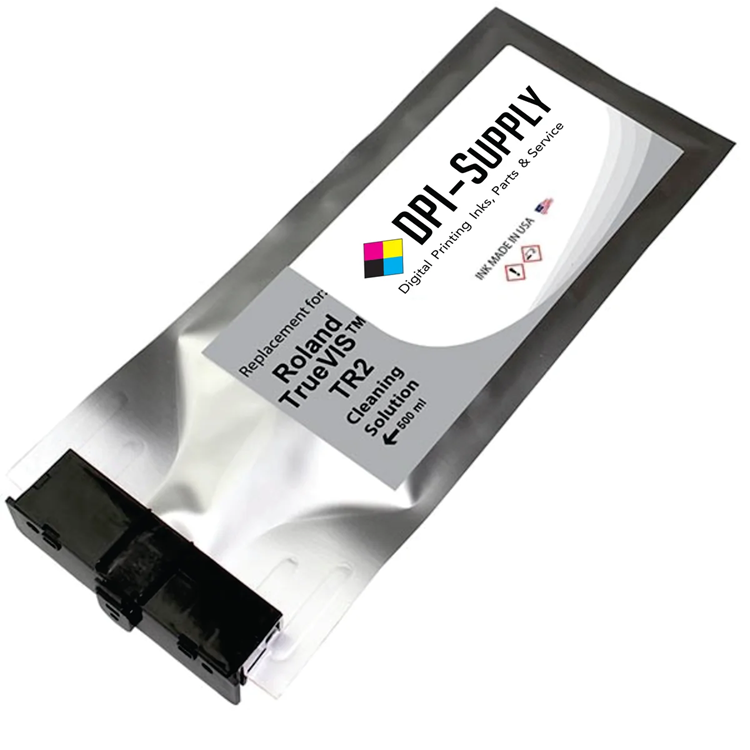
Shops seeking a cost-conscious option can review TR2 Replacement Ink for Roland TrueVIS VG2 printers. DPI Supply offers 500 ml options in multiple colors, along with cleaning solution. Confirm the printer, color configuration, changeover instructions, profile expectations, and warranty considerations before switching.
Do not assume that an OEM outgassing certification automatically applies to every replacement formula. Test color, drying behavior, lamination, cutting, and adhesion under actual production conditions. I would start with a saturated sample because demanding artwork exposes workflow differences more clearly than a low-coverage test.
Build a Safer TR2 Production Workflow
Record print completion times and establish drying rules based on the media, profile, coverage, and application. Keep high-coverage vehicle graphics separate from simple decals when setting finishing schedules. When a documented combination allows faster lamination, follow the entire approved system rather than selecting only the shortest wait time.
DPI Supply is a reliable source for digital printing inks and supplies for Roland, Mimaki, HP, Epson, Mutoh, and other production platforms. Shops can compare ink options while finding cleaning products, replacement parts, and related materials. Confirming compatibility before ordering protects the printer and makes production results more predictable.
Protect the Adhesive by Respecting Drying Time
Can TR2 Ink Damage Vinyl Adhesive If It Is Not Fully Dry? It can interfere with adhesion and film stability when remaining solvent is trapped beneath laminate or rushed into installation. Proper outgassing gives the ink time to stabilize and allows the vinyl and adhesive to perform as intended.
TR2 ink can deliver excellent color, durability, and efficient turnaround, but speed should come from a tested workflow rather than guesswork. Use the correct profile, manage ink coverage, provide airflow, follow product guidance, and test unfamiliar combinations. Those steps reduce reprints and help the finished graphic remain where it belongs.